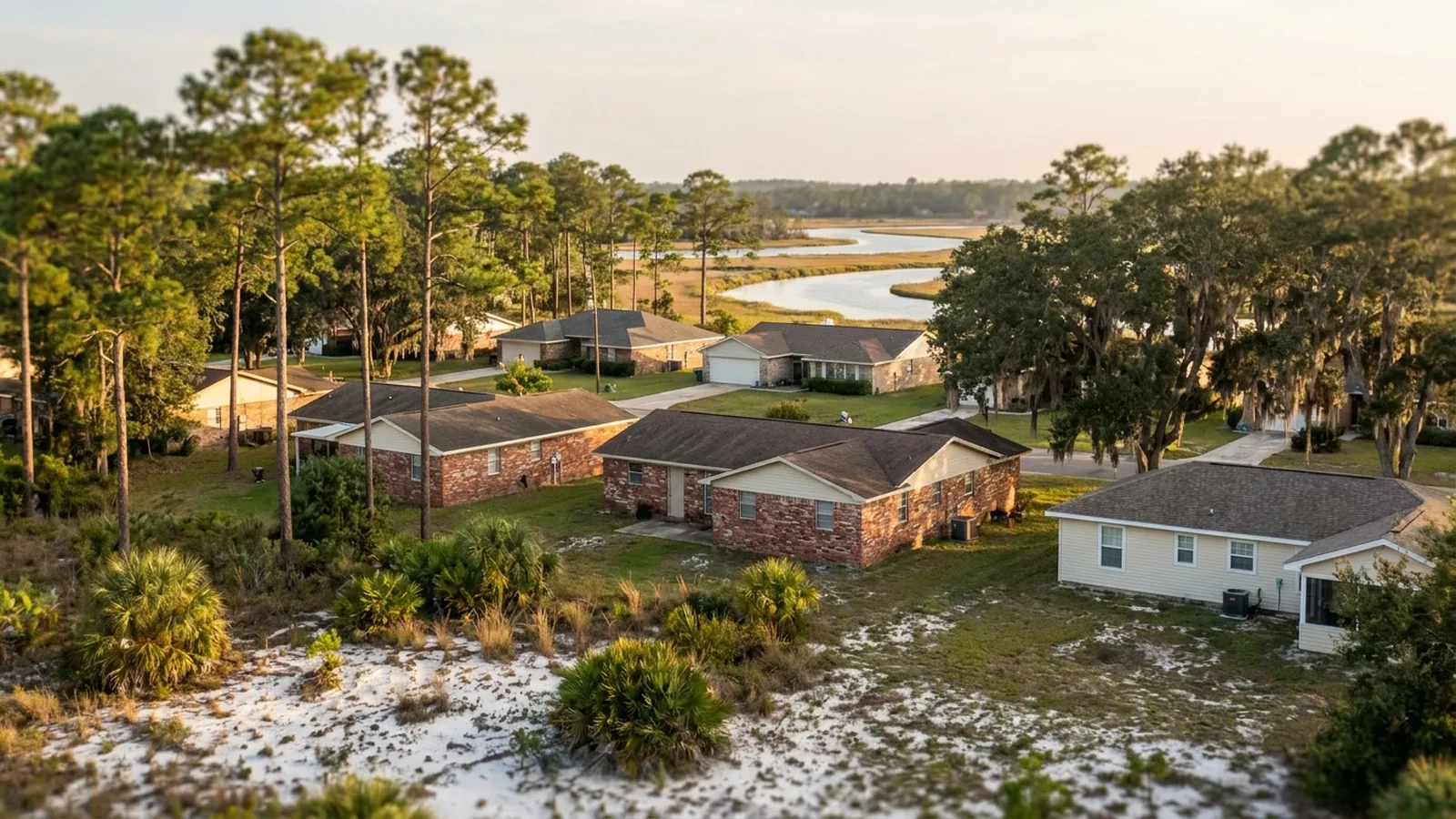
Foundation repair for settlement in Panama City runs $4,000–$15,000, with piers commonly $1,200–$3,000 each. Bay County’s organic soils hold 50–60% organic material and compress under building load. Ask whether the elevation survey is charged.
What consolidation is, why it never reverses, and how the floor tells you whether it has finished.
Two grounds, one county
The USDA soil survey for Bay County maps both of them clearly, and a house sitting on one has almost nothing in common with a house sitting on the other.
| Ground | What the survey records | Under a house |
|---|---|---|
| Ridge sand — Foxworth series | 93–96% sand, 0.25–1.25% organic matter, to 80 inches | Carries load without complaint and always has |
| Bayou and flat — Pamlico muck | About 50% organic material to roughly 32 inches, over sand | Compresses under load until the load and the ground balance |
| Marsh margin — Dorovan muck | 50–60% organic material to 60 inches, over sand | The same, over a thicker layer, so further to travel |
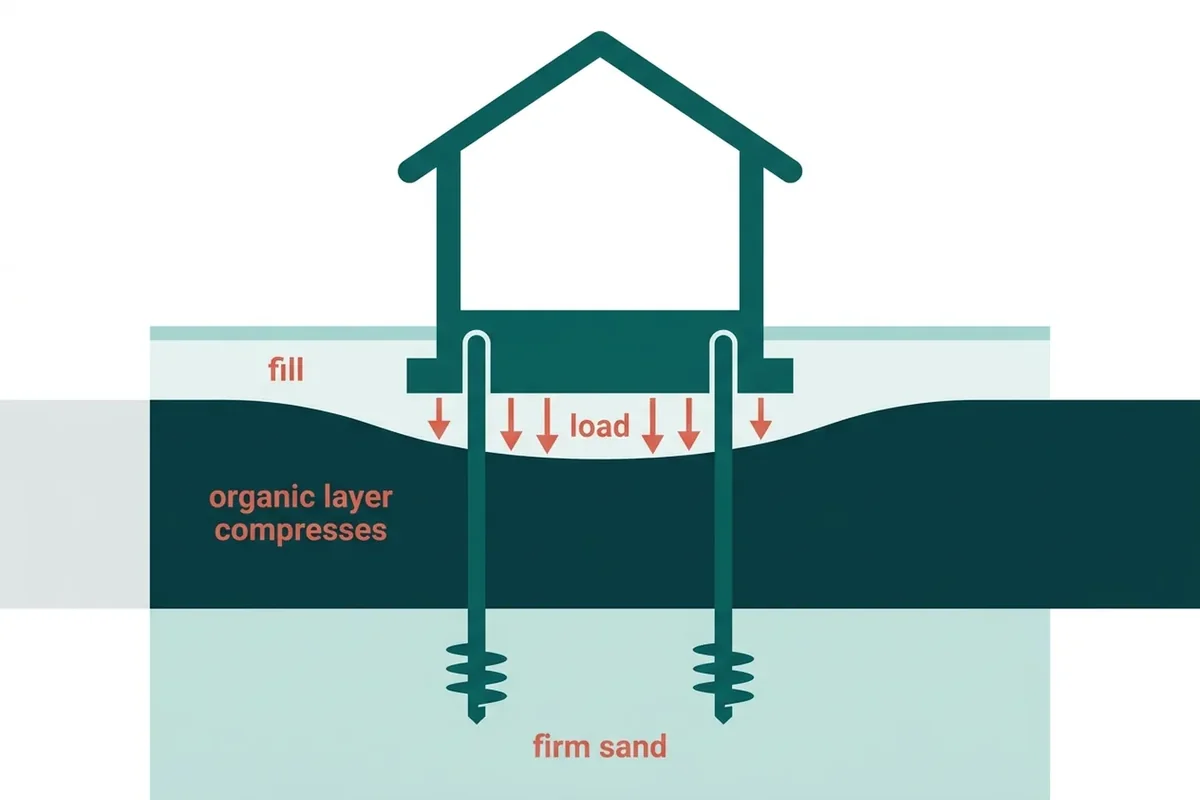
Fifty percent organic material is not soil in the sense a builder means it. It is compressible material with a great deal of water and void space in it, and putting a house on top of it removes some of that space permanently.
Why it never reverses
This is the difference that catches people who have owned a house somewhere else. In expansive clay country the ground swells in the wet season and shrinks in the dry one, so damage opens and closes and homeowners learn to wait it out.
Consolidation does not work that way. The material compressed under a building load has lost void space, and rain does not put void space back. Whatever settlement has already occurred is permanent, and the only useful question is whether more of it is still coming.
Which is a question about time, not appearance
Consolidation is slow and continuous. It runs fastest early, slows as the ground approaches equilibrium, and eventually stops. A house may complete most of its settlement in five years or still be working through it at fifteen, depending on how thick the compressible layer is and how much load sits on it.
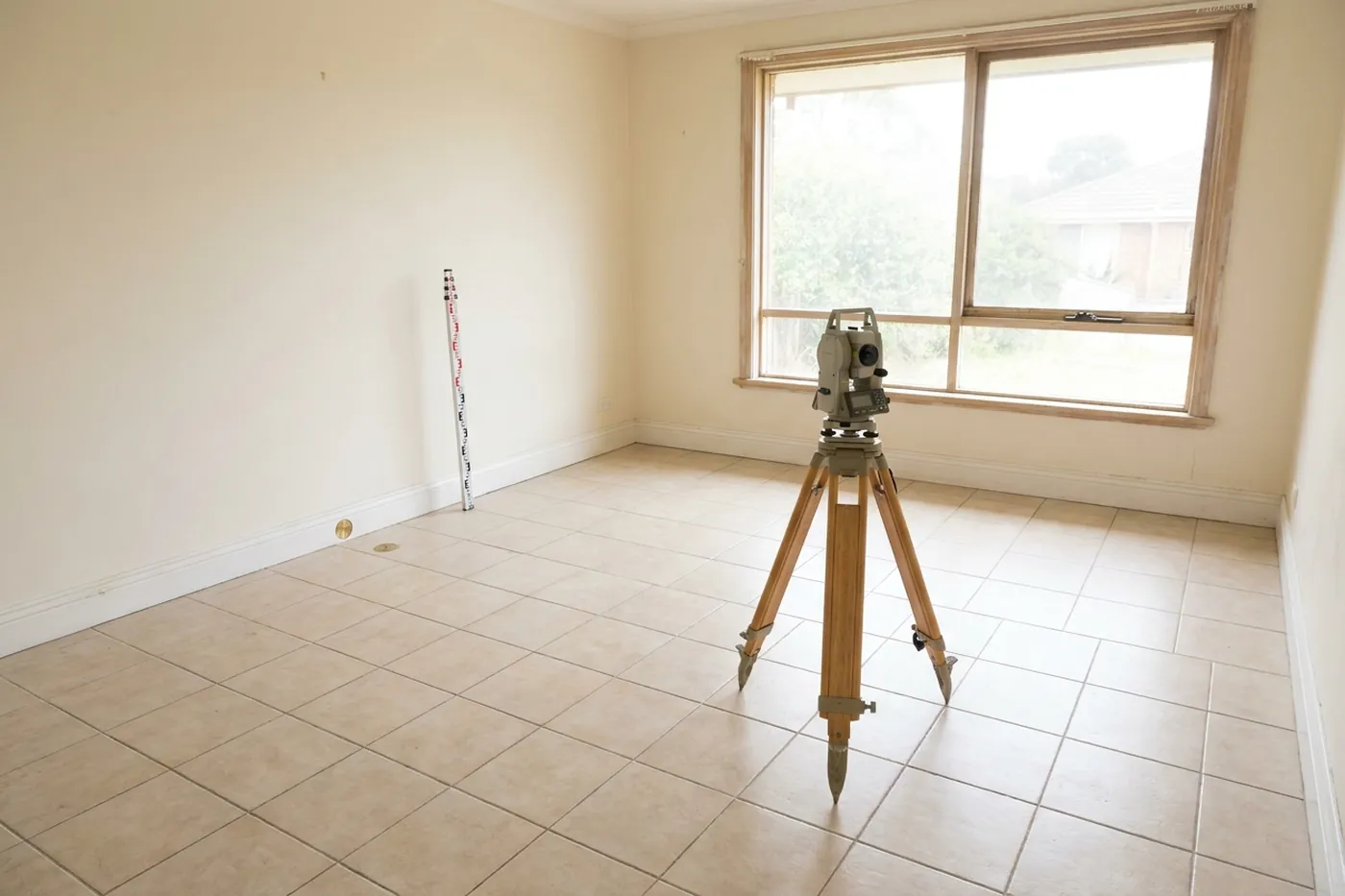
So the single most valuable thing to establish is whether your house is still moving — and that genuinely cannot be answered by one visit, however experienced the person looking. It is answered by measuring twice, months apart, from fixed reference points. A house that has not moved between two surveys has told you something no crack ever will.
What foundation repair actually does here
Where movement is finished, nothing. Where it is ongoing, the load has to reach past the compressible layer to material that will carry it, because adding support at the surface of something that is still compacting simply gives it more to compact.
| Finding | The work | Range |
|---|---|---|
| Settlement complete, floor out of level | Releveling only, or nothing at all | $0–$12,000 |
| Movement ongoing, compressible layer shallow | Helical piers to firm sand | $1,200–$3,000 per pier |
| Movement ongoing, layer deep | Piers, longer, and fewer illusions about the price | Toward $15,000 |
| One corner or addition only | Localised support where the load path fails | $4,000–$9,000 |
| Unclear which of the above | Monitor, then decide | Ask the specialist |
What to be wary of
A pier count quoted from a photograph, a repair priced before the floor has been measured, or being told that a crack means your foundation is failing. Cracks are how people find out something is happening; they are close to worthless for working out what.
A foundation contractor is also not a geotechnical engineer. They do not drill borings or issue geotechnical reports, and where a job genuinely needs one, a good specialist will say so and you should engage a firm that does that work. See what can be established and where the line sits.
Settlement, answered plainly
What does foundation repair cost in Panama City?
Budget $4,000-$15,000 for a complete job, and $1,200-$3,000 for each pier that goes in. Depth is what moves that figure: a pier that finds firm sand at 9 feet costs a fraction of one driven to 30 feet through organic material. The elevation survey establishes it; ask whether it is charged.
Why does my newer house have worse settlement than my neighbour's older one?
Because consolidation is driven by load and time, not by age. A 1962 house on ridge sand finished settling before anyone reading this was born. A 2021 house on a pad built over compressible ground is still working through its settlement, and will be for some years yet.
Will the ground push back up in the wet season?
The ground won't push back up in the wet season. That is expansive clay behaviour and it is not what happens here. Organic material compressed under a building load does not recover when it rains. Nothing on this coast reverses, which is why waiting to see whether it improves is not a strategy that pays.
How do I know it is settlement and not something else?
Relative floor elevations across the whole footprint. A settlement pattern falls away toward one area in a consistent gradient. Framing shrinkage, slab curl and ordinary cracking do not produce that pattern, and telling them apart from a photograph of a crack is not possible.
Does it ever stop on its own?
Frequently, and that is the outcome worth looking for first. Consolidation is not infinite - it runs until the ground under the load equilibrates. A great many houses here finished moving years ago and need nothing but a record that says so.
Is a crack in the slab an emergency?
Very rarely. Cracks are the symptom people notice and the least informative thing in the house. What matters is whether the floor has gone out of level and whether that is still changing, and neither of those is visible in a crack.
Book a Panama City elevation survey
Tell us roughly when the house was built and whether the lot was raised or filled before it went up — even “I think they trucked dirt in” is worth knowing. On this ground the age of the house and the history of the pad narrow the answer faster than any description of a crack. A local specialist who serves Panama City will call you back.