
Settlement monitoring answers the one question a single foundation repair visit cannot: whether your house is still moving. Two elevation surveys from fixed reference points, three to six months apart. Ask whether the first is charged and what the second costs.
Why time is the instrument on this mechanism, what a second survey proves, and what a stable result is worth.
The question nobody can answer by looking
A house that settled between 2009 and 2013 and has been perfectly still ever since looks exactly like a house settling right now. Same cracks. Same doors out of square. Same sloping floor. The damage is a record of movement that happened, and it says nothing whatever about whether movement is continuing.
This is the single most common way money gets wasted on foundation repair in Bay County: a homeowner pays to stabilise a house that finished stabilising itself a decade ago. Nobody necessarily lied to them. The information required to know better simply was not gathered.
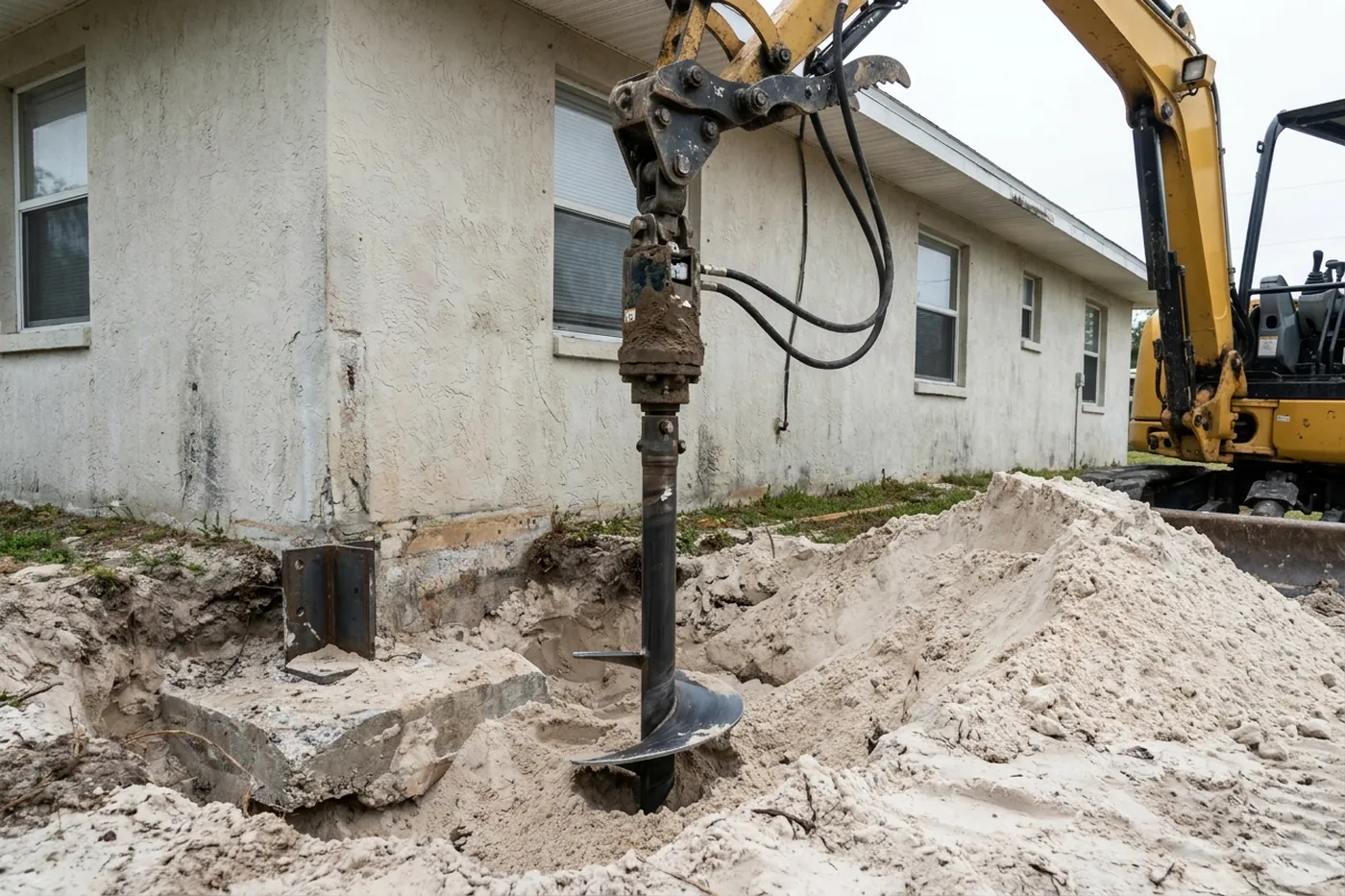
Why foundation repair here needs elapsed time
Consolidation is slow and one-way. Organic material under load loses void space gradually, quickly at first and then more slowly as it approaches equilibrium, and it never recovers. That has an awkward consequence and a useful one.
The awkward one: no single measurement can distinguish a house partway through the process from one that finished. The useful one: because the process is continuous rather than episodic, two measurements separated by months will differ if it is ongoing. On a mechanism like sand washout, where damage arrives on the day of a storm, monitoring would tell you far less.
How it works
| Step | What happens |
|---|---|
| Survey one | Relative floor elevations across the whole footprint, plus permanent reference marks |
| The interval | Three to six months, longer where nothing is urgent |
| Survey two | The same points, the same instrument, the same reference marks |
| The comparison | Change at each point, with the instrument tolerance stated alongside |
| The conclusion | Stable, moving, or too close to call — in which case, a third survey |
The reference marks matter more than the instrument does. Measuring from a different datum the second time produces a difference that means nothing, and that is the most common way monitoring gets done badly.
What a stable result is worth
- A written record for a sale, when a buyer’s inspector flags a sloping floor
- Grounds to decline a repair that a company has told you is urgent
- The ability to spend the money on cosmetic releveling instead, if the slope bothers you, without buying support you do not need
- A baseline, so that if something does change in five years there is something to compare to
When waiting is the wrong advice
Where the movement is visibly fast — a crack that has opened measurably in weeks, a door that was fine in spring and will not close in autumn, separation that is widening while you watch — monitoring is the wrong advice and a good specialist will say so. That pace is not consolidation and it points at something else, possibly a plumbing leak or a drainage failure carrying material away.
The point of monitoring is not to delay. It is to avoid buying settlement repair for a house that stopped settling before you bought it.
Monitoring, answered plainly
What does settlement monitoring cost?
Ask the specialist whether the initial elevation survey is charged, and what re-measurements from the same reference points will cost. It is worth establishing that a house is stable before buying foundation repair it may not need.
How long between surveys?
Usually three to six months, and longer is better where the situation is not urgent. Consolidation is slow, so a short interval risks reading noise as movement. Where something is clearly active the interval should be shorter, but the honest default is a season apart.
What counts as still moving?
A consistent change in relative elevation at the same points, in the same direction, beyond the tolerance of the instrument. One point reading differently is measurement scatter. A pattern of points falling together over months is settlement.
Why can't anyone just tell me from looking?
Because nothing visible distinguishes a house that settled in 2011 and stopped from one settling right now. Both have cracks. Both have doors that stick. The only difference is whether the numbers change between two dates, and that requires two dates.
What if it turns out to be stable?
Then you have a written record showing it, which is worth having when you sell, when an inspector raises it, or when the next contractor tells you the house is failing. That is a real outcome and it happens often.
Does waiting make repairs more expensive?
Not usually, on this mechanism. Consolidation is slow and a few months rarely changes the scope, which is exactly why monitoring is affordable advice here. Where a house is actively and rapidly moving, a good specialist says so and does not suggest waiting.
Book a Panama City elevation survey
Tell us roughly when the house was built and whether the lot was raised or filled before it went up — even “I think they trucked dirt in” is worth knowing. On this ground the age of the house and the history of the pad narrow the answer faster than any description of a crack. A local specialist who serves Panama City will call you back.