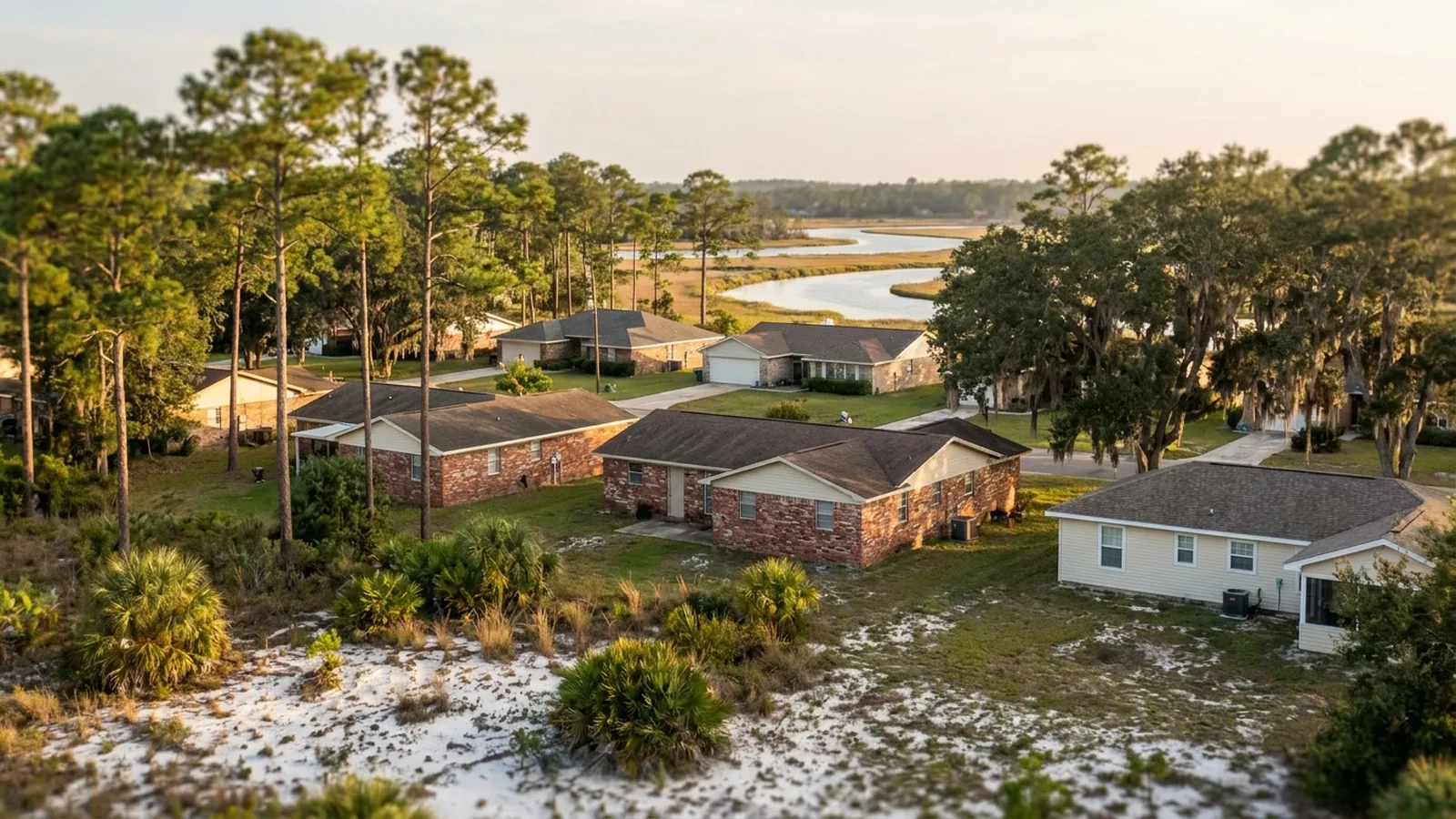
Foundation repair in Panama City costs $4,000–$15,000, with piers at $1,200–$3,000 each. Bay County’s organic soils hold 50–60% organic material and compress under building load. Ask whether the elevation survey is charged.
The two natural grounds, the third one that arrived by truck, and how to tell whether your house has finished moving.
Two grounds, one county
The USDA soil survey for Bay County describes them plainly, and a house on one has almost nothing in common with a house on the other.
| Ground | What the survey records | Under a house |
|---|---|---|
| Ridge sand — Foxworth series | 93–96% sand, 0.25–1.25% organic matter, to 80 inches | Stable. Has carried houses here for as long as there have been houses |
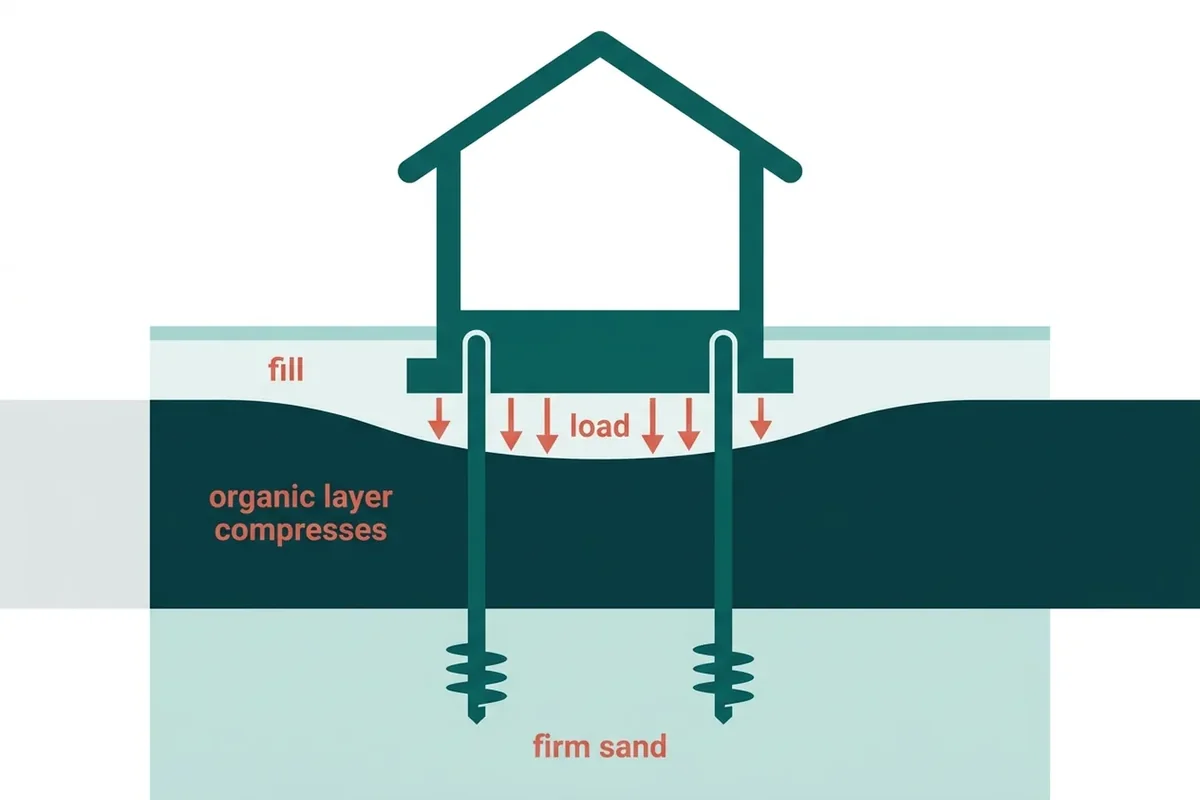
| Bayou flat — Pamlico muck | About 50% organic material to roughly 32 inches, sand beneath | Compresses under load, slowly, permanently |
| Marsh margin — Dorovan muck | 50–60% organic material to 60 inches, sand beneath | The same, with considerably further to go |
Both muck series are mapped very poorly drained, which is how they became organic in the first place: material accumulated in standing water faster than it broke down. Excellent wetland, poor bearing.
And a third one, which arrived by truck
Because nobody founds a house on 50 percent organic material, the low ground gets raised instead. A great deal of the developed flat around the bay and the bayous is placed fill, and fill is the most variable material on any site — excellent where it went down in tested lifts, a settlement problem where it did not. Both look identical once grass has grown.
Florida Building Code 1804.6 requires fill deeper than 12 inches under a shallow foundation to follow an approved geotechnical report. So on a raised pad, a document describing your ground was supposed to exist — see the fill rules and where to go looking for it.
The question that actually matters
Not what the cracks look like. Whether it is still moving.
Consolidation is slow, continuous and one-way, which has an awkward consequence: a house that settled between 2009 and 2013 and has been perfectly still since looks exactly like one settling today. Same cracks, same sticking doors, same sloping floor. Nothing visible separates them.
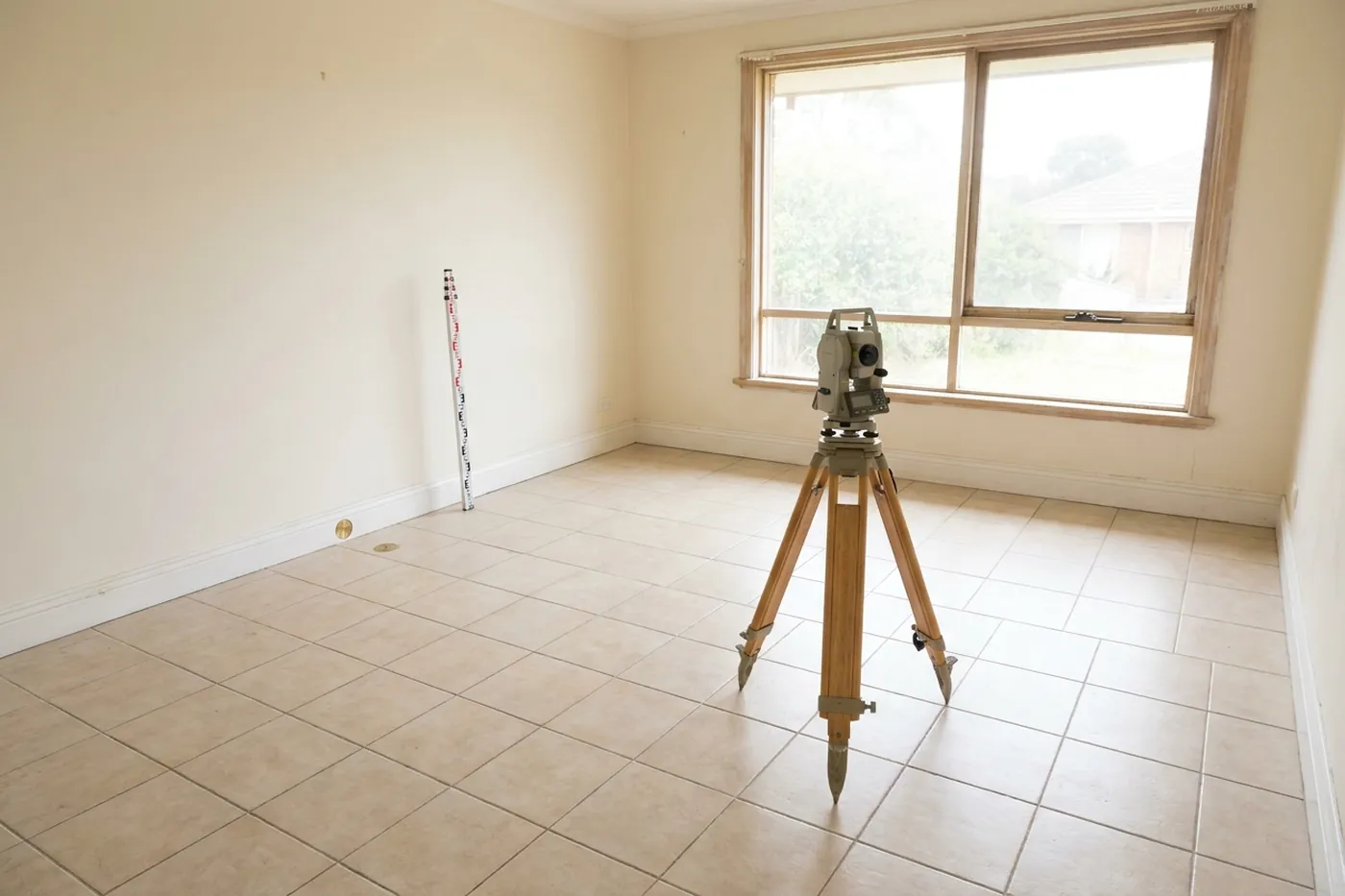
What separates them is two measurements. Relative floor elevations from fixed reference points, taken months apart, either change or they do not. That is the whole diagnostic, and it is the reason to ask for a survey before a quote. How the monitoring works.
What the work covers
Settlement Repair
Ground that compacts under load, and what it takes to carry a house past it.
Helical Piers
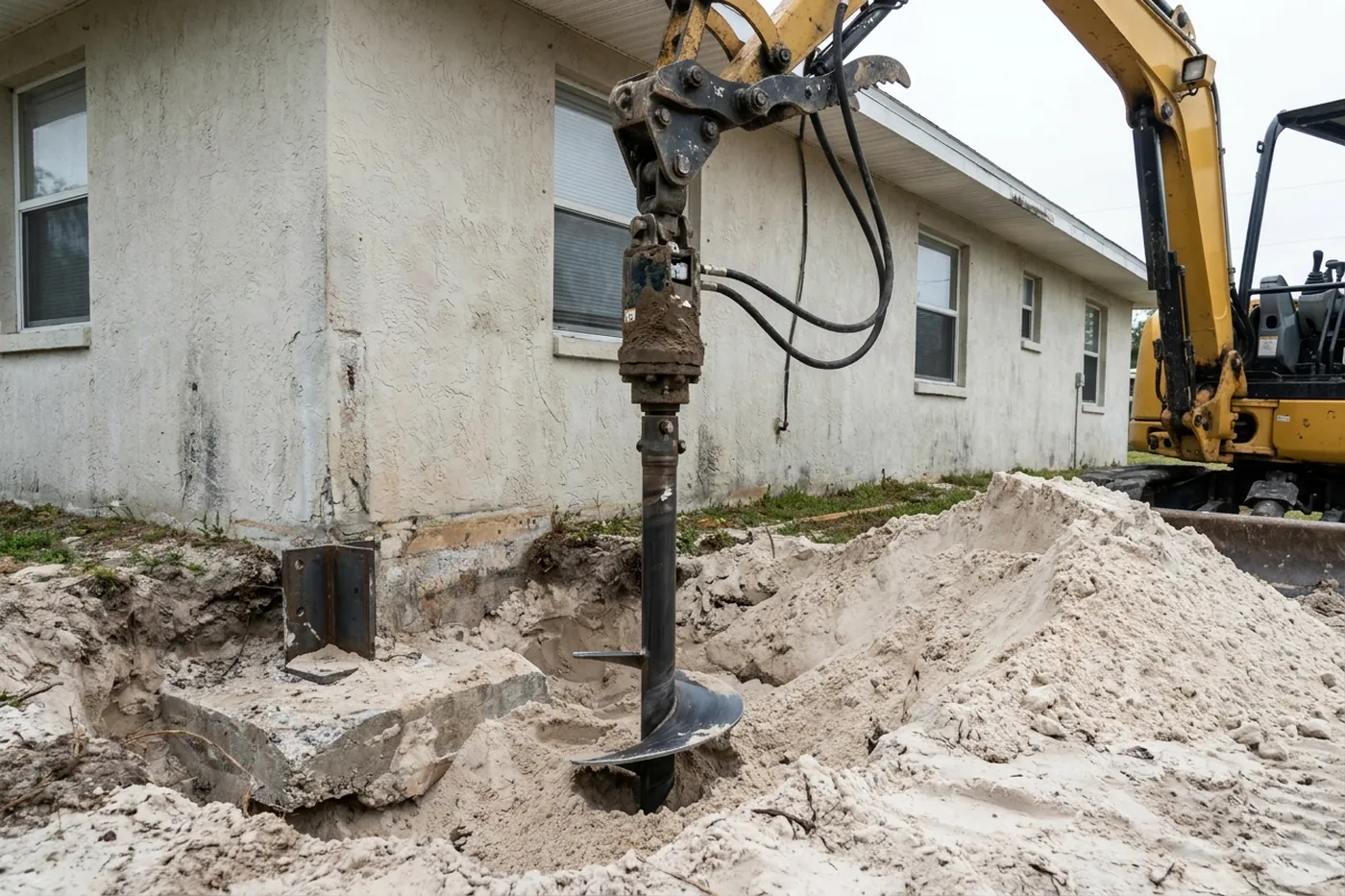
Depth to firm sand sets the price here — not how many piers get counted.
Is It Still Moving?
Two surveys, months apart. The one question a single visit cannot honestly answer.
What You Are Built On
Ridge sand or bayou muck, native ground or a pad somebody trucked in.
House Releveling
Putting elevation back — and the cases where that is the wrong thing to do.
New Houses That Move
Why a 2021 build can be settling while the 1962 house next door never has.
Reading the Cracks
What a crack can tell you, what it cannot, and why it is the weakest evidence in the house.
The Fill Rules
Florida Building Code 1804.6, and the report that should exist if your pad was built up.
What it costs
| Work | Range | Applies when |
|---|---|---|
| First elevation survey | Often free; ask | Ask for it before any quote |
| Monitoring, 12 months | Ask the specialist | Whenever “is it still moving” is open |
| Probing for fill depth | $300–$900 | The lot looks raised, or the house is recent |
| Helical piers | $1,200–$3,000 each | Movement is ongoing and load must reach past it |
| Complete settlement repair | $4,000–$15,000 | Several piers, priced by depth to firm sand |
| House releveling | $3,000–$12,000 | Elevation recovery, after any support work |
Full breakdown on the Panama City cost guide.
Where requests are taken
Across Bay and Gulf counties. Ask the specialist whether travel is priced in.
Lynn Haven · Callaway · Springfield · Parker · Panama City Beach · Mexico Beach · Southport · Youngstown · Port St. Joe
Full list on the service areas page.
What a good survey includes
- Relative floor elevations across the whole footprint, written down with the points marked
- Permanent reference marks, so a second survey measures from the same datum
- An exterior walk for drainage and for signs the lot was raised
- A straight statement of whether the pattern looks like settlement or like something else
- Any rival document you hold, checked for the depth it quietly assumed
An honest specialist will sometimes lose a job by telling somebody their house finished moving a decade ago. There is no other honest way to work on ground like this. See what to ask for, what a crack can and cannot show, or book the survey.
The questions we get asked
How much does foundation repair cost in Panama City?
Reckon on $4,000-$15,000 for a complete job, $1,200-$3,000 for each pier, and $3,000-$12,000 to relevel a house. Probing to establish what your pad is made of runs $300-$900. Ask the specialist whether the first elevation survey is charged, and what a second survey or longer monitoring costs.
Why does the ground here move at all?
Because a good deal of it is organic. The USDA maps Pamlico muck at roughly 50 percent organic material to about 32 inches and Dorovan at 50-60 percent to 60 inches. Material like that compresses under a building load, slowly and permanently.
Will it swell back when it rains?
It won't swell back when it rains. That is expansive clay behaviour and this is not clay country. Consolidation is one-way: the void space that came out under load does not go back in. Nothing here reverses, which is why waiting to see if it improves does not work.
How do I know whether my house is still moving?
Two elevation surveys from the same fixed reference points, three to six months apart. That is genuinely the only way, and anybody claiming to know from a single look at a crack is telling you more than the evidence supports.
My house is new. Surely it cannot be the foundation?
That intuition runs backwards here. Consolidation follows load and time, so a 1962 house on ridge sand finished settling long ago while a 2021 house on a raised pad is early in the process, which is exactly when movement is fastest.
Is there a charge to come out to Gulf County?
Ask the specialist whether the first visit is charged in Gulf County, as in Bay, and whether the price changes with the length of the drive. Where a quote climbs the further out you are, the journey has been priced into a line item and it is fair to ask them to point at it.
Book a Panama City elevation survey
Tell us roughly when the house was built and whether the lot was raised or filled before it went up — even “I think they trucked dirt in” is worth knowing. On this ground the age of the house and the history of the pad narrow the answer faster than any description of a crack. A local specialist who serves Panama City will call you back.